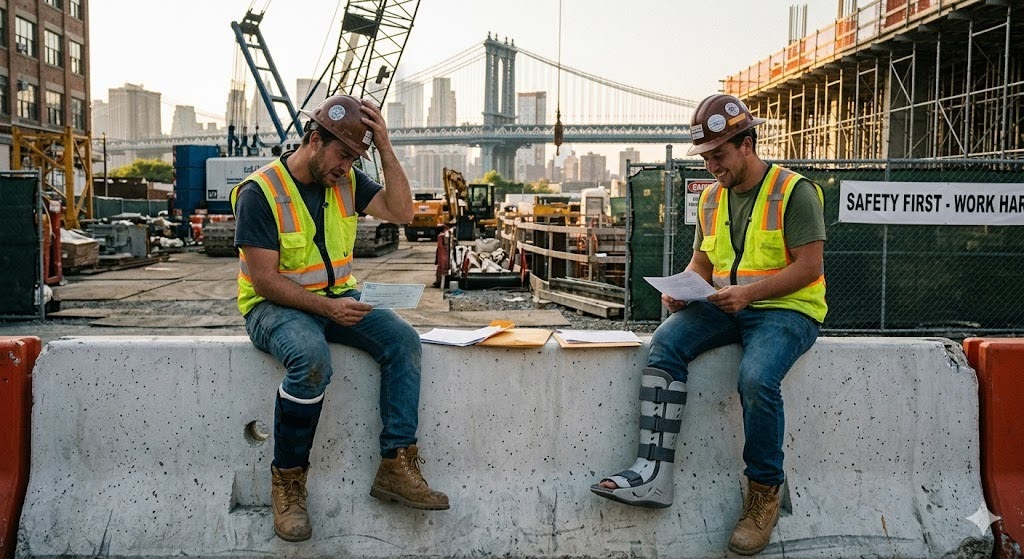
Why Two Workers With the Same Injury End Up With Wildly Different Payouts
How does a guy on the same job site, with what looks like the same broken ankle, walk away with three times what his coworker got?
I hear that question more than almost any other. It comes in late at night, usually from a spouse or a shop steward, sometimes from the worker himself sitting at a kitchen table in Sunset Park or Bay Ridge trying to make sense of a number that doesn’t feel right. The frustration underneath the question is always the same: Was I played? Did someone else get a favor? Is this whole thing just who you know?
It isn’t random. The difference almost always comes down to a handful of concrete factors that nobody bothered to explain in plain English. That’s what I want to do here.
The Same Injury Is Never Really the Same Case
Picture two ironworkers. Both fall from scaffolding on a Brooklyn job site within six months of each other. Both fracture their left ankle. One settles for $180,000. The other settles for $620,000.
Same borough. Same type of accident. Same bone. Different outcomes.
| Factor | Worker A ($180K) | Worker B ($620K) |
|---|---|---|
| Prior injury | Yes — prior ankle damage from car accident | None |
| Medical documentation | Fracture noted; old vs. new trauma unclear | Two surgeries, hardware implant, documented nerve damage |
| Return to work | Light duty within 8 weeks | Could not return to foreman classification |
| OSHA findings | No violations found | Contractor cited 6 months earlier for separate fall hazard |
| Annual earnings | Not specified | $94,000 as foreman |
That’s not luck. That’s the case file.
Why Liability Isn’t as Simple as “I Fell at Work”
The first thing that shapes settlement value is who’s legally responsible—and in construction, that question is almost never simple.
On a typical Brooklyn job site, you’ve got a property owner, a general contractor, one or more subcontractors, and sometimes a separate site safety manager. When a worker gets hurt, every one of those parties has potential exposure, and every one of them has a lawyer and an insurance company working to minimize it. New York Labor Law, particularly Sections 240 and 241, gives injured construction workers stronger protections than most states. But those protections only translate into money if someone builds the case to show which party or parties failed their duty.
This is where the employer and contractor relationship matters enormously. If you were employed by a subcontractor but the general contractor controlled the site conditions, both can be liable. If the property owner knew about a hazard and did nothing, they’re in the picture too. More defendants with overlapping insurance policies generally means more total coverage available to compensate a serious injury.
OSHA findings can be a significant lever here—or a missed opportunity. If OSHA investigated your accident and cited the contractor for a safety violation, that citation doesn’t automatically win your case, but it creates a documented record that a professional safety agency found something wrong. I’ve had cases where an OSHA report was the single most persuasive document in the file. I’ve also had cases where a worker was seriously hurt but OSHA found no violation, which made the liability argument harder and the insurance company more aggressive in its initial offer.
What about partial fault? New York follows comparative fault rules, which means a jury can assign a percentage of blame to the injured worker. If you’re found 20% at fault, your recovery is reduced by 20%. Insurance companies know this, and they use it. If there’s any evidence a worker bypassed a safety protocol, removed a harness, or ignored a direct instruction, expect the adjuster to lean on that hard. It doesn’t eliminate the claim—but it changes the math.
The Numbers That Actually Drive the Offer
Here’s something insurance adjusters don’t advertise: they often run your claim through a software system that weights your medical bills heavily—sometimes as the primary anchor for the entire valuation.
Pain and suffering, loss of enjoyment of life, the psychological toll of not being able to coach your kid’s soccer team anymore—those things are real, but they’re harder to quantify. Medical bills are concrete. That’s why they matter so much to the other side. Before you accept anything, make sure your attorney has compiled the gross billed amount of every treatment, surgery, physical therapy session, and specialist visit. That number is the foundation the insurance company is building from, even if they’re trying to minimize it.
Lost wages are the other major economic driver, and they’re often undervalued in early offers. Three things get missed constantly:
- Overtime — For a construction worker making $85,000 to $110,000 a year, overtime can represent 20–30% of total annual income
- Benefits and pension contributions — These disappear during recovery and are rarely factored into the first offer
- Permanent earning capacity reduction — If the injury prevents a return to the same classification, the loss extends for years, not months
Permanent disability is where the largest settlement values live. A 42-year-old ironworker with a permanent spinal injury has potentially 20-plus years of lost earning capacity ahead of him. That number, properly documented by the right medical and vocational experts, is what separates a $200,000 settlement from a $1.2 million one. The injury type matters, but the permanence and the documentation of its impact on work capacity matter more.
The Evidence Timeline: What Gets Built Before Anyone Talks Settlement
Settlement value isn’t just about what happened. It’s about what got documented, when, and by whom.
The first 72 hours are critical. Was an incident report filed? Did the worker seek medical treatment immediately, or did he try to tough it out for a week? Insurance companies treat gaps in treatment as evidence that the injury wasn’t serious. It’s not fair, but it’s how the system works.
After that initial window, the evidence that shapes a case gets built over months. Medical records need to tell a coherent story—injury, treatment, response, prognosis. If a worker sees three different doctors who give inconsistent assessments, the insurance company’s adjuster will use that inconsistency to argue the injury is exaggerated or unrelated to the accident. Consistency in treatment and clear medical documentation isn’t just good health practice; it’s case-building.
For workers in Brooklyn and across New York City, the involvement of a personal injury attorney early in the process can change what evidence gets preserved. Witness statements fade. Surveillance footage gets overwritten. Site conditions change. An attorney who knows construction cases can send preservation letters to the contractor and property owner, request OSHA inspection records, and retain an independent safety expert before the site is cleaned up and everyone moves on.
Geography matters too. Brooklyn juries understand what construction work looks like, what the risks are, and what it means to lose that work permanently. That local context is part of the calculation—the same way experienced construction accident attorneys in boston understand how their local court dynamics shape case value in their jurisdiction. Every venue has its own track record, and knowing it changes how a case gets built.
Quick Answers to the Questions I Hear Most
“My neighbor had a similar injury and his attorney said it was a clear case. Why is mine more complicated?”
Pre-existing conditions are usually the answer. If you had a prior back injury, a previous workers’ comp claim, or any documented treatment for the same body part that’s now injured, the insurance company will argue that your current condition is partly or entirely pre-existing. New York law recognizes that an accident can aggravate a pre-existing condition and that aggravation is compensable—but the medical evidence needs to work harder to separate the old damage from the new.
“The insurance company made an offer quickly. Is that a good sign?”
Usually the opposite. Fast offers tend to come before the full extent of an injury is documented. Accepting early locks in a number that doesn’t account for future surgeries, long-term therapy, or permanent limitations that haven’t fully declared themselves yet.
“Does it matter how big the contractor is?”
Yes—because policy limits are a real ceiling. Even a well-documented, serious injury can be constrained by how much insurance coverage exists. A small subcontractor with minimal coverage is a fundamentally different situation than a major general contractor with a $10 million policy. Understanding the insurance landscape on your specific job site is part of what a good attorney does before the first settlement conversation.
What to Do Right Now
If you or someone in your family was hurt on a Brooklyn construction site and the number you’re hearing doesn’t feel right, here’s where to start.
- Get the full picture of your medical bills — the gross billed amount, not the insurance-adjusted figure
- Document every day of work missed — include overtime, not just base pay
- Find out whether OSHA was called and whether any citations were issued
- Identify all parties — the general contractor, property owner, and any subcontractors on site
- Ask about prior safety complaints on that specific job site
Then talk to an attorney who handles construction cases specifically—not a general practice firm that takes everything. Ask them directly: what factors in my case could increase or decrease the value? What evidence do we still need to build?
A straight answer to those questions tells you whether you’re talking to someone who will actually fight for what your case is worth.
The difference between two settlements isn’t luck. It’s the file.